Today’s post is less thoroughly researched, but I’m trying to do more with getting my research out there casually rather than comprehensively. (As the saying goes, “perfect is the enemy of good.”)
The topic was inspired by an episode of the podcast I co-host (The Storming Journey — a sacred text reading of The Stormlight Archive). The theme for the episode was “Agency,” and of course, since we talk about the book’s connection to Mormonism, we were musing on the Mormon concept of agency.
For awhile now, one of my friends has pointed out that the only place that “moral agency” is used in the scriptures is in D&C 101:78:
That every man may act in doctrine and principle pertaining to futurity, according to the moral agency which I have given unto him, that every man may be accountable for his own sins in the day of judgment.
However, I think it’s valuable to put this verse into context, so here’s the surrounding verses (76-80):
[76] And again I say unto you, those who have been scattered by their enemies, it is my will that they should continue to importune for redress, and redemption, by the hands of those who are placed as rulers and are in authority over you—[77] According to the laws and constitution of the people, which I have suffered to be established, and should be maintained for the rights and protection of all flesh, according to just and holy principles; [78] That every man may act in doctrine and principle pertaining to futurity, according to the moral agency which I have given unto him, that every man may be accountable for his own sins in the day of judgment.
[79] Therefore, it is not right that any man should be in bondage one to another.
[80] And for this purpose have I established the Constitution of this land, by the hands of wise men whom I raised up unto this very purpose, and redeemed the land by the shedding of blood.
Basically, the only use of moral agency anywhere in the scriptural canon is where it is wrapped up in a discussion of how governments should act.
(It’s here where I would normally go off on an extended research session to find papers written about moral agency and its connections to government and its usage, but that is not actually what I’m here to share, so we’re forging onward [ever onward].)
Growing up, I do remember the idea of “it’s not free agency” being reiterated at church. I don’t remember substituting free with moral, but rather dropping the modifier altogether. However, it appears that in General Conference talks, at least, leaders were swapping the modifier from moral to free.
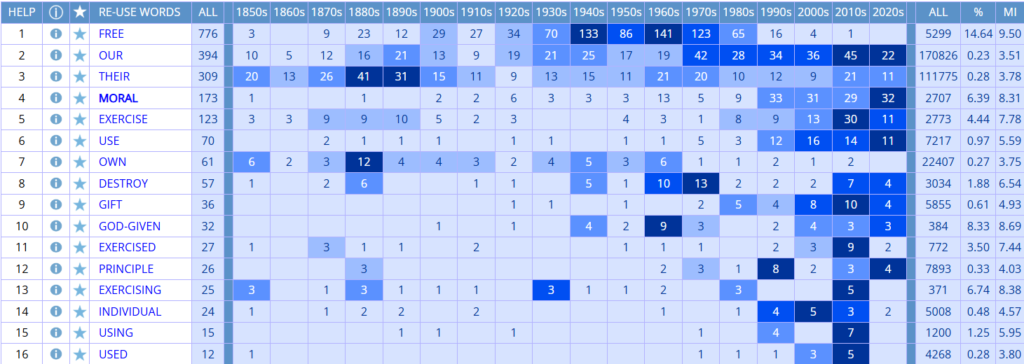
| Collocate | Total | 1850s | 1860s | 1870s | 1880s | 1890s | 1900s | 1910s | 1920s | 1930s | 1940s | 1950s | 1960s | 1970s | 1980s | 1990s | 2000s | 2010s | 2020s |
|---|---|---|---|---|---|---|---|---|---|---|---|---|---|---|---|---|---|---|---|
| FREE | 776 | 3 | 9 | 23 | 12 | 29 | 27 | 34 | 70 | 133 | 86 | 141 | 123 | 65 | 16 | 4 | 1 | ||
| OUR | 394 | 10 | 5 | 12 | 16 | 21 | 13 | 9 | 19 | 21 | 25 | 17 | 19 | 42 | 28 | 34 | 36 | 45 | 22 |
| THEIR | 309 | 20 | 13 | 26 | 41 | 31 | 15 | 11 | 9 | 13 | 15 | 11 | 21 | 20 | 10 | 12 | 9 | 21 | 11 |
| MORAL | 173 | 1 | 1 | 2 | 2 | 6 | 3 | 3 | 3 | 13 | 5 | 9 | 33 | 31 | 29 | 32 | |||
| EXERCISE | 123 | 3 | 3 | 9 | 9 | 10 | 5 | 2 | 3 | 4 | 3 | 1 | 8 | 9 | 13 | 30 | 11 | ||
| USE | 70 | 2 | 1 | 1 | 1 | 1 | 1 | 1 | 1 | 5 | 3 | 12 | 16 | 14 | 11 | ||||
| OWN | 61 | 6 | 2 | 3 | 12 | 4 | 4 | 3 | 2 | 4 | 5 | 3 | 6 | 1 | 1 | 2 | 1 | 2 | |
| DESTROY | 57 | 1 | 2 | 6 | 1 | 1 | 5 | 1 | 10 | 13 | 2 | 2 | 2 | 7 | 4 | ||||
| GIFT | 36 | 1 | 1 | 1 | 2 | 5 | 4 | 8 | 10 | 4 | |||||||||
| GOD-GIVEN | 32 | 1 | 1 | 4 | 2 | 9 | 3 | 2 | 4 | 3 | 3 | ||||||||
| EXERCISED | 27 | 1 | 3 | 1 | 1 | 2 | 1 | 1 | 1 | 2 | 3 | 9 | 2 | ||||||
| PRINCIPLE | 26 | 3 | 2 | 3 | 1 | 8 | 2 | 3 | 4 | ||||||||||
| EXERCISING | 25 | 3 | 1 | 3 | 1 | 1 | 1 | 3 | 1 | 1 | 2 | 3 | 5 | ||||||
| INDIVIDUAL | 24 | 1 | 1 | 2 | 2 | 2 | 1 | 1 | 4 | 5 | 3 | 2 | |||||||
| USING | 15 | 1 | 1 | 1 | 1 | 4 | 7 | ||||||||||||
| USED | 12 | 1 | 1 | 1 | 1 | 3 | 5 |
There is a very substantial drop off in usage of moral agency in the 1980s going into the 1990s. The precipitating talk for this shift appears to be a talk by Boyd K. Packer in April 1992 (“Our Moral Environment“) where he explicitly condemns the use of free agency and suggests moral agency:
The phrase “free agency” does not appear in scripture. The only agency spoken of there is moral agency, “which,” the Lord said, “I have given unto him, that every man may be accountable for his own sins in the day of judgment” (D&C 101:78; italics added).
What makes this especially fascinating is that this passage is situated in a discussion of governance. Before the above quote, Packer argues:
While we pass laws to reduce pollution of the earth, any proposal to protect the moral and spiritual environment is shouted down and marched against as infringing upon liberty, agency, freedom, the right to choose.
Interesting how one virtue, when given exaggerated or fanatical emphasis, can be used to batter down another, with freedom, a virtue, invoked to protect vice. Those determined to transgress see any regulation of their lifestyle as interfering with their agency and seek to have their actions condoned by making them legal.
People who are otherwise sensible say, “I do not intend to indulge, but I vote for freedom of choice for those who do.”
Flawed Argument
Regardless of how lofty and moral the “pro-choice” argument sounds, it is badly flawed. With that same logic one could argue that all traffic signs and barriers which keep the careless from danger should be pulled down on the theory that each individual must be free to choose how close to the edge he will go.
At least two years earlier, moral agency and free agency were used interchangeably, as in Derek A. Cuthbert’s April 1990 talk, “The Spirituality of Service,” where he explains:
Even many of those who profess to understand free agency, or moral agency, turn liberty to license, as we can see all around us.
After Packer’s 1992 talk, there were few holdouts for using free agency. Only five leaders have used free agency since 1992 (Gordon B. Hinckley, Chieko Okazaki, Richard E. Cook, James E. Faust, and Keith K. Hilbig; other uses from L. Tom Perry were from older quotations). However, of those five, only James E. Faust used moral agency as well. Since he’d used it at least once before Packer’s 1992 talk, I’m inclined to think that he generally used them interchangeably. My personal theory is that he didn’t see a difference between moral agency and free agency and used the former to minimize disputes with Packer. In comparison, if we look at usage of agency by Gordon B. Hinckley, he seems to have generally dropped using any modifiers after 1995 (with one exception in 2006).1
To a minor degree, there has also been a shift from talking about their agency to talking about our agency. Based on my familiarity with Mormon history, I’d suggest the earlier usage of their is an echo of a retrenchment effort and attempting to distance the Mormon community from the world as a whole. The use of our is less a reflection of assimilation/retrenchment efforts, and I would argue it’s more related to a broader trend away from community salvation and towards individual/family salvation.2
In general, I find the use of verbs around agency to be fascinating. It can be used, of course, but it’s more frequently exercised. It’s also something that can be destroyed; this Conference usage is rooted in Moses 4:3, but the fact that the phrasing is so frequently quoted is notable. I’m still musing over what I think the implications of this are, so I’d love to hear your thoughts!
Finally, I took a look at the usage of agency in the Corpus of Historical American English (COHA) for comparison, using the same parameters as my search in the Conference corpus. Almost every top collocation was some variation of a type of agency: intelligence, protection, environmental, news. This suggests that the way that Mormons talk about agency is very different than most people talk about agency.
If I (or someone else) was going to look into this further, here’s what I’d consider:
- What other scholarship is out there regarding agency in Mormonism? Is there any research on the shift from free agency to moral agency? If that research isn’t in corpus linguistics, can this data (or data like it) be used to validate the research that’s already been done?
- How does the use of agency show up in other LDS corpora, such as manuals or magazines? Is there a particular leader who has been in the impetus for this shift? (My current hypothesis is that it was spearheaded by Packer, which [in my opinion] explains why Bednar seems to encourage the use of moral agency.)
- Is there a difference in how agency is used in religion in general, or is it really just Mormonism in particular? How does it show up across religions (Christian, Jewish, Muslim, etc.)? How does it show up in denominations (Mormon, Catholic, Evangelical, etc.)?
Feel free to use any of these research ideas, as long as you share your findings!
- I’m not going to paste the corpus results into this blog post, but they’re easily located by searching the General Conference corpus for agency using the “List” display; click on “AGENCY” in the results, and then on “LIMITS,” add “Gordon B. Hinckley” under “Speaker.” ↩︎
- I have more thoughts on this that I’d like to type up at some point, but it’s rooted in the shift away from “building Zion” to “staying on the covenant path” that I’ve noticed anecdotally. ↩︎
